
The sharks you'll meet on the water
Silky Sharks in Cancun
The resident apex predator of the Mexican Caribbean — present year-round, 30 nautical miles offshore
What Is a Silky Shark?
The silky shark (Carcharhinus falciformis) gets its name from the unusually smooth, almost silken texture of its skin — finer-scaled than most shark species and unmistakable up close.
It is one of the most abundant open-ocean sharks in the world, ranging across tropical and subtropical seas from the Pacific to the Atlantic. In the Mexican Caribbean, silky sharks are a permanent presence in the deep blue water beyond the reef — not seasonal visitors, not transient migrants, but true residents of these waters.
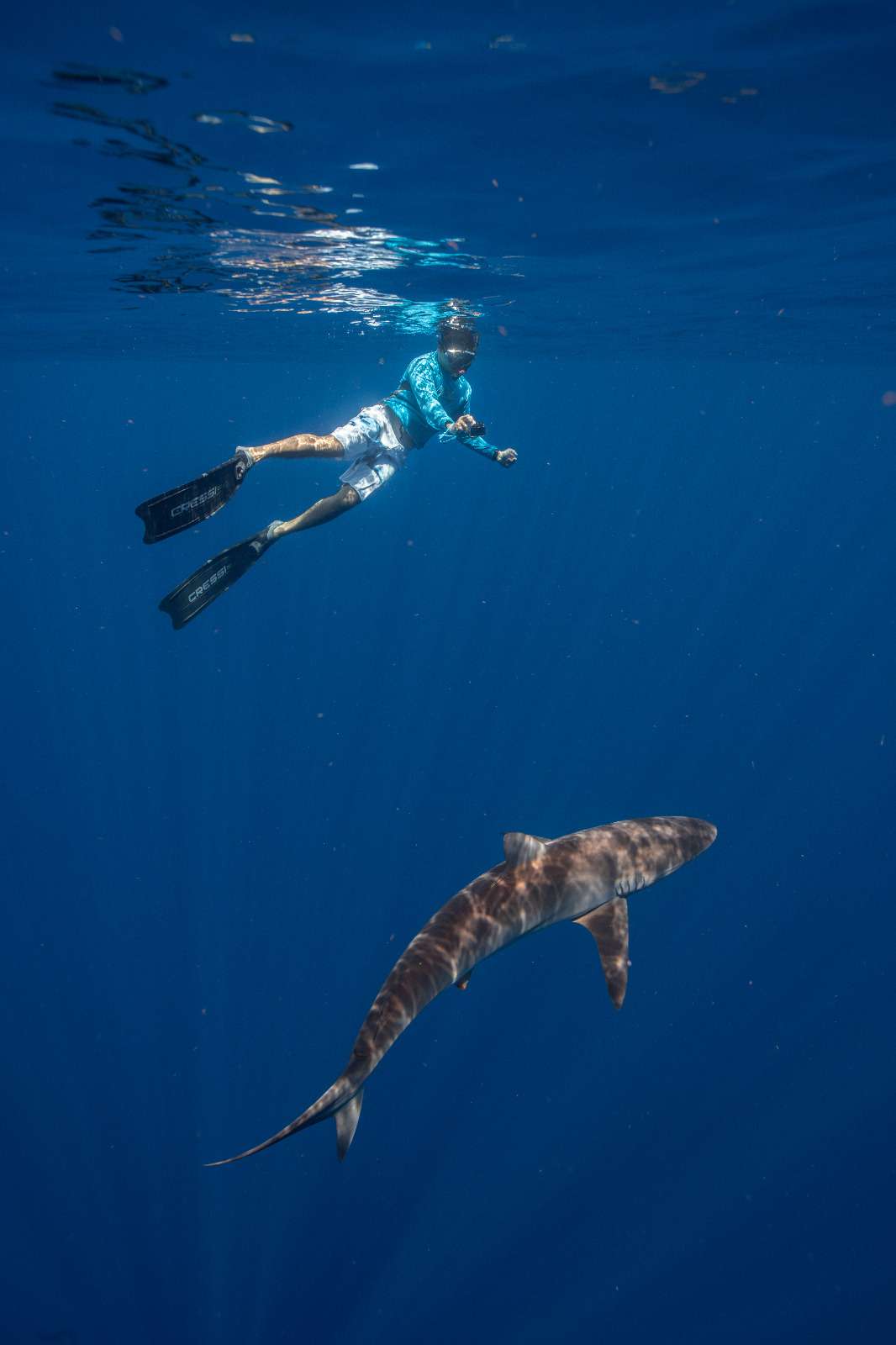
Adults typically reach between 2 and 2.5 meters in length and weigh between 45 and 90 kilograms. Their build is streamlined and powerful — long pectoral fins, a rounded snout, and the fluid, unhurried movement of an animal that owns its environment. In the water, they are graceful in a way that is genuinely difficult to describe until you have seen it firsthand.
Why Do Silky Sharks Gather Near Cancun?
The waters off the northern Yucatán Peninsula create a near-perfect convergence of conditions for silky sharks year-round.
The Gulf Stream pushes warm, nutrient-rich water along the shelf edge. The reef system that runs south from Isla Mujeres funnels baitfish — yellowfin tuna, mackerel, and flying fish — into concentrated schools in open water. Where baitfish gather, silky sharks follow. It is not complicated biology. It is one of the most reliable predator-prey relationships in the Caribbean.
What makes this location extraordinary is the consistency. Unlike the seasonal whale shark aggregations that draw tourism from June to September, or the bull shark diving operations further south in Playa del Carmen which are tied to specific temperature and current windows, silky sharks are here in January, in April, in August, in November. Every month of the year. That consistency is what makes Cancun uniquely valuable as a destination for this experience.
Are Silky Sharks Dangerous?

Silky sharks are wild apex predators. That is not a warning — it is what makes this encounter worth having.
They are also not aggressive toward humans in open water. The International Shark Attack File documents very few unprovoked incidents involving silky sharks globally, and none in the context of supervised snorkeling encounters. Their behavior in the water tends toward curiosity rather than aggression — they approach, assess, and move on.
That said, this is not an encounter to attempt without professional guidance. Our guides have spent years in the water with these animals. They understand behavioral cues, appropriate positioning, and how to read a shark’s body language before it communicates anything more obvious. Every guest is briefed on exactly how to behave before entering the water — how to move, where to position yourself, what to avoid.
The sharks are wild. The risk is managed. Those two things coexist, and both are true.
Adventure meets Conservation
Adrenaline, conservation, and so much fun in total respect of nature!
When you swim with sharks on our tour, you help them to be worth more alive than dead!
95%
Success rate in our trips
+100
Trips operated per year
+30
Years of experience
Silky Shark Facts
- Scientific name: Carcharhinus falciformis
- Family: Carcharhinidae (requiem sharks)
- Average length: 2 to 2.5 meters
- Average weight: 45 to 90 kilograms
- Lifespan: 20+ years in the wild
- Diet: Bony fish, squid, and pelagic invertebrates
- Range: Global tropical and subtropical oceans
- Depth: Surface to 500 meters, most active in the top 50 meters
- Gestation: 12 months, 2 to 14 pups per litter
- Primary threats: Longline fishing bycatch, targeted fin trade
- Mexico protection: Partial, under NOM-029
- Conservation status: Vulnerable — IUCN Red List
What Silky Shark Behavior Will You See Underwater?
No two encounters are identical, but there are patterns.
Silky sharks typically approach the group from below or from distance, moving in slow, wide arcs before closing the gap. They are visual hunters — their large eyes are adapted to the blue-water pelagic environment, and they will look directly at you in a way that most animals do not. It is one of the more disorienting and memorable moments of the encounter.
You will see them accelerate when baitfish are present and slow to an almost meditative pace when they are simply patrolling. You will see the pectoral fins drop slightly when they are relaxed and flatten when they are more alert. You will see the way open water moves around an animal built entirely for it.
Encounters typically run between 30 and 60 minutes in the water, with between 2 and 8 sharks present depending on conditions and time of year. Our 95% success rate means that on the vast majority of trips, sharks are encountered.
Conservation Status and Why It Matters
When you book a shark tour with us, you are making an economic argument.
Commercial fishing operations have historically targeted silky sharks for their fins — a high-value commodity in international markets. The logic of that trade only changes when living sharks generate more value than dead ones. Responsible shark tourism is one of the few mechanisms that creates that equation at scale.
Every charter we run is a data point: a living silky shark off the coast of Cancun generated $1,299 in revenue today. It will do the same tomorrow, and next week, and next year. A finned shark generates revenue once.
We work alongside the local diving community and support ongoing documentation of silky shark presence in these waters. Your dive contributes to that record.
Ready to Swim with Silky Sharks?
No certification required. No prior experience needed. Year-round availability from Cancun and Isla Mujeres.
Our private charter puts your group in the water with professional guides who have spent years alongside these animals. Gear is provided, photos are included, and the encounter is unlike anything else available in the Mexican Caribbean.